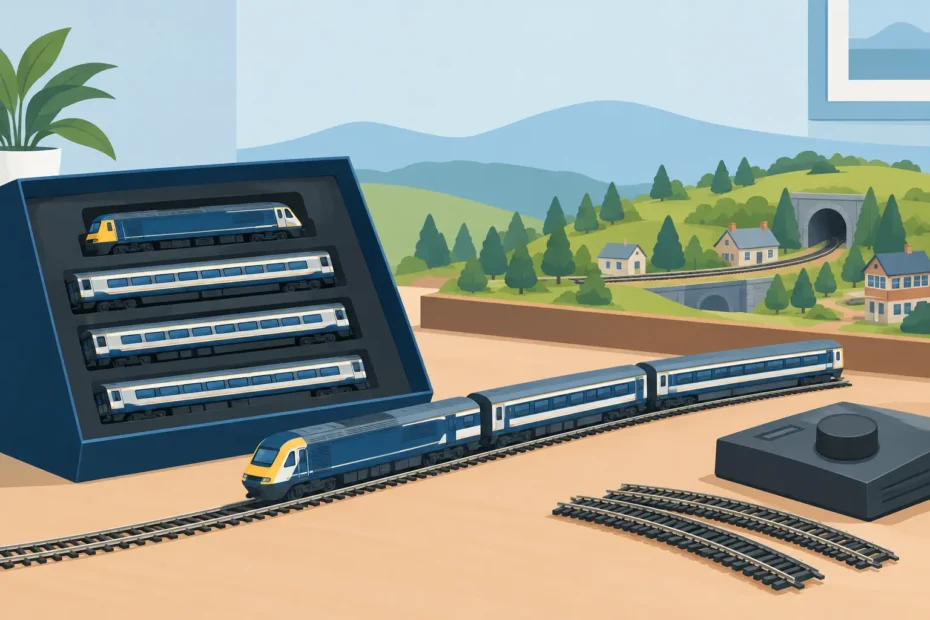
A spare shelf, a corner of a study or a compact board can become a convincing railway scene with the right N gauge train set. At 1:148 scale in the UK, N gauge gives you a great deal of railway in a modest footprint: longer platforms, gentler-looking curves, passing loops and trains with enough coaches to suggest a proper main line. It is a favourite scale for enthusiasts who want operational interest without giving an entire room to the hobby.
That smaller size does bring a few considerations. Track needs careful laying, locomotives reward light-handed handling, and tiny details can be less forgiving than their OO gauge equivalents. Choose well, however, and a starter set is far more than a first purchase. It can become the working heart of a layout built around the era, region and railway story you enjoy most.
What comes in an N gauge train set?
Most starter sets are designed to get a train running straight from the box. You will usually find a locomotive, coaches or wagons, an oval or basic circuit of track, a controller and a power connection. Some sets include a track mat, while others leave the scenery and baseboard entirely up to you.
The exact contents matter. A passenger set may include a locomotive and two or three coaches, offering an immediate sense of a complete service. A freight set can provide a locomotive with several wagons, which is ideal if you prefer shunting, goods yards and industrial scenes. Both are legitimate starting points; the better choice is the one that makes you want to run the railway again tomorrow.
Do not assume that every box contains every item needed for a permanent layout. A set will normally get you started, but baseboards, buildings, ballast, platforms, additional points and extra rolling stock are usually separate purchases. That is part of the appeal: you can begin simply, then add character at your own pace.
Start with the space, not the locomotive
It is tempting to choose a train first, particularly when a favourite livery or famous locomotive catches the eye. Before deciding, measure the place where the railway will live. Include room around the board for reaching trains, fitting a controller and carrying out the occasional rescue when a wagon derails in a tunnel.
A basic oval is ideal for learning how N gauge track fits together, but an oval alone can soon feel limiting. If space allows, plan for a siding, passing loop or small station from the outset. Even a modest extension gives a train somewhere purposeful to go and creates opportunities to shunt wagons or cross passenger services.
Curve radius deserves particular attention. Tighter curves help a set fit into a smaller area, but they can look less natural and may restrict what you add later. Longer coaches and certain locomotives generally look better on broader curves. If you hope to run modern multiple units, full-length express stock or long rakes of coaches, allow as much room as possible.
A small, well-finished layout is often more satisfying than an over-ambitious project that never reaches the stage where trains can run. A compact branch terminus, a rural station with a goods siding, or a two-platform through station can all tell a convincing story in N gauge.
Think about the layout’s future
The starter track is a useful beginning, not a rulebook. Check that any extra track you intend to buy is compatible with the track system supplied in the set. Sticking with one established system at the beginning keeps the process straightforward, especially with points, electrical connections and track geometry.
It is also worth sketching a rough plan before buying expansions. You do not need technical drawing skills. Mark the board dimensions, the original oval and the position of any station, siding or scenic feature. Seeing it on paper can prevent the common disappointment of bringing home an appealing building or platform that is too large for the space available.
DC or DCC control: which suits your railway?
A conventional analogue, or DC, starter set is simple and excellent for a first layout. The controller adjusts the speed and direction of the locomotive, and there is less to set up before you can enjoy running trains. For a single-train railway, or for a family gift where immediate running matters most, DC is a sensible choice.
Digital Command Control, usually known as DCC, gives each fitted locomotive its own address. That means more than one locomotive can be controlled independently on the same section of powered track. DCC can also support functions such as directional lighting and sound on suitably equipped models.
The trade-off is cost and complexity. A DCC-ready locomotive is designed to accept a decoder, but it is not necessarily supplied with one installed. DCC-fitted means a decoder is already present. For newcomers, those terms are easy to confuse, so always read the product description carefully before planning a digital railway.
There is no need to buy every digital feature at the start. A traditional controller and a good starter set offer plenty of enjoyment, and many layouts make the move to DCC later. The important thing is to buy with an honest view of how you want to operate the railway, rather than choosing technology simply because it sounds more advanced.
Pick an era and a railway story
A cohesive layout does not have to reproduce a real location exactly. It simply needs a believable identity. Choosing an era makes later decisions easier, from locomotive liveries and coach types to station signs, vehicles and advertising boards.
Steam-era modellers may enjoy the variety of tank engines, branch-line passenger coaches, vans and mineral wagons. The British Railways transition period offers the pleasure of steam alongside early diesel classes. A modern image layout can feature multiple units, container traffic, engineers’ trains and contemporary station scenes.
You may also prefer a particular region or operator, whether that is a rural Western branch, a busy East Coast main line, a Northern industrial yard or a fictional line inspired by several favourites. A fictional setting gives useful freedom. It lets you run the models you like without worrying that every vehicle appeared together in real life.
For gift buyers, the recipient’s railway memories are often the best guide. A childhood holiday route, a local station, a parent’s former workplace or a much-loved class of locomotive can make an N gauge purchase feel personal rather than generic.
Add the pieces that make trains feel at home
Once the first circuit is running reliably, add scenery and accessories in layers. Trackside buildings and platforms establish scale quickly, while a few figures, parked cars and fencing give a scene a sense of purpose. N gauge rewards restraint. A carefully placed signal box, goods shed and station canopy can look more effective than filling every corner with models.
Reliable running should come before detailed scenery. Lay track on a flat, stable surface, make sure rail joins sit properly, and keep the rails clean. Light locomotives can be affected by dust, loose ballast and uneven joints more readily than heavier models in larger scales. A gentle clean of wheels and track is one of the simplest ways to avoid frustrating stops and jerks.
When buying extra rolling stock, look at coupling compatibility, wheel condition and the type of train you are assembling. A short local goods service can look excellent with only a handful of wagons, while a main-line express benefits from a consistent rake of coaches. Quality, proportion and a believable combination matter more than sheer quantity.
Why N gauge remains such a rewarding choice
N gauge is not merely OO gauge made smaller. Its real strength is the way it lets a compact layout show distance and movement. A train can disappear behind a hill, cross a bridge, call at a station and reappear from a tunnel in a space where larger scales might allow only a simple circuit.
It is also a scale that grows with you. A first set can remain a relaxed weekend railway, or become the foundation for more ambitious track plans, digital operation and detailed scenery. There is room for the collector who wants a favourite locomotive in the cabinet and the operator who wants a busy timetable with passenger, parcels and freight services.
At Darlington Diecast, the enjoyment is in finding the set, locomotive or accessory that suits your own railway rather than following somebody else’s rules. Start with a train you genuinely like, give it track that runs well, and leave enough space in the plan for the next idea that comes along. That is how a small railway begins to feel like your railway.