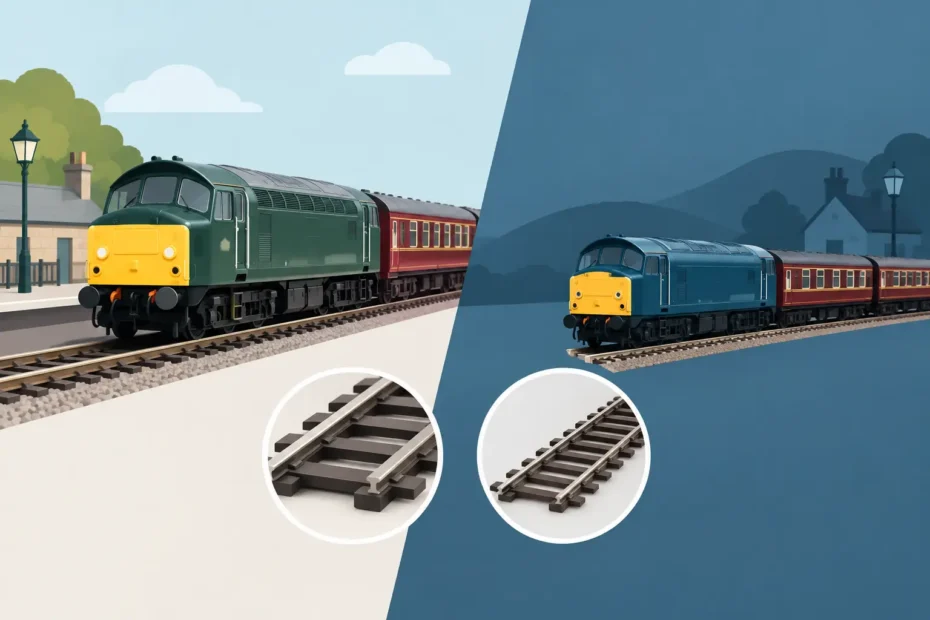
A station platform that feels comfortably long in OO can become a much more ambitious main-line scene in TT:120. That is the central question in OO gauge versus TT:120: do you want the established British standard with enormous choice, or a smaller scale that makes better use of limited space? Neither is automatically the right answer. Your room, budget, preferred era and the sort of railway you want to operate all matter.
For many UK modellers, OO is familiar territory. It has supplied generations of first train sets, carefully built layouts and detailed locomotive collections. TT:120 is the newer contender in British ready-to-run modelling, bringing 1:120 scale back into focus with a growing range of locomotives, rolling stock, track and buildings. It is small enough to create a noticeable change in what can be achieved on a board, but large enough for satisfying detail and hands-on operation.
OO Gauge Versus TT:120: The Essential Difference
OO models are built to 1:76.2 scale, often described as 4 mm to the foot, and run on 16.5 mm gauge track. TT:120 models are 1:120 scale and use 12 mm track. In practical terms, a TT:120 locomotive is roughly 64 per cent of the length and height of its OO equivalent.
That sounds like a modest reduction until you look at the layout footprint. A scene takes up area as well as length, so TT:120 can allow almost two and a half times as much railway in the same space. A modest spare-room layout in OO might portray a compact branch terminus. In TT:120, the same area may accommodate longer platforms, broader curves, a more believable goods yard or a stretch of open countryside between stations.
OO’s 16.5 mm track is wider than strict scale would suggest for standard-gauge railways, a long-standing compromise inherited from the scale’s early history. TT:120’s 12 mm track is very close to correct for standard gauge at 1:120. For some enthusiasts, especially those interested in track geometry and a more proportional appearance, that is a genuine attraction. For most newcomers, however, the visible difference matters less than the finished scene and how enjoyably it runs.
When OO Gauge Makes the Better Choice
OO remains the natural choice for a great many British railway enthusiasts, and for good reason. Its range is exceptionally broad. Whether your interest is pre-grouping railways, BR steam, diesel hydraulics, modern image freight or a favourite preserved line, there is a deep catalogue of locomotives, coaches, wagons, structures, scenic materials and accessories to explore.
That choice also makes OO forgiving. It is easier to find a particular class of locomotive, an unusual wagon, a replacement part or a suitable road vehicle for the period you are modelling. Bachmann, Hornby, Dapol, Accurascale, Heljan and a host of specialist manufacturers have all contributed to a mature OO scene. Second-hand tables, exhibitions and fellow modellers provide another useful source of stock and knowledge.
The larger size is helpful when fitting couplings, adding weathering, installing a DCC decoder or working with small scenic details. OO is not large in the way O gauge is large, but it is substantial enough to handle with confidence. A young enthusiast building their first layout with adult help, or a returning modeller whose close-up eyesight is not what it was, may find that reassuring.
OO also rewards collectors. A locomotive, lorry, station sign or period bus can make a strong display piece on its own, while 1:76 diecast vehicles sit naturally alongside most OO layouts. If you enjoy matching road transport to the railway period, this is a significant advantage. An early 1960s diesel depot, for example, gains a great deal from the right cars, delivery vans and service vehicles around it.
The trade-off is space. OO can look cramped if curves are too sharp or platforms are shortened to fit the available board. There is nothing wrong with a compact plan, particularly for shunting, industrial railways or a branch-line terminus. But a modeller hoping for long express trains, sweeping curves and a convincing rural run will need a sizeable room, garage or loft.
Why TT:120 Is Winning Attention
TT:120 offers a persuasive middle ground between OO and N gauge. It is meaningfully smaller than OO without asking modellers to work at the finer, more delicate scale of N. That makes it particularly appealing for flats, box rooms, studies and layouts that need to be stored between sessions.
A board around 120 cm by 80 cm can support a satisfying TT:120 project, although the exact plan depends on the track pieces, curve radii and operating ambitions. Increase the available length and the benefits become clearer. Longer rakes of coaches appear less compressed, scenic breaks have room to breathe and a double-track main line becomes more realistic rather than a tight oval with buildings pressed against the rails.
TT:120 is also an attractive option for modellers returning after a long break. Modern ready-to-run releases provide impressive decoration, fine printing and digital-control capability, while the smaller scale encourages a fresh approach to layout planning. Rather than reproducing the same OO track plan in less space, it invites you to think about what the extra scenery, longer platforms or additional sidings could add to the railway.
There is a collecting appeal too. TT:120 locos and rolling stock take less display space than their OO counterparts, so it is possible to build a varied fleet without filling every shelf. For a gift buyer, a starter set can be an inviting route into a proper modelling hobby rather than a short-lived toy.
Its limitation is range maturity. The British TT:120 catalogue is expanding, but it is not yet comparable to OO for breadth of eras, liveries, accessory choices and specialist prototypes. Before committing, check that the locomotives and stock you genuinely want are available now, announced with a credible release date, or can be represented through the wider 1:120 market. It is wise to plan around products you can buy, not only the railway you hope eventually to build.
Layout Space Changes the Answer
The best way to choose between the scales is to measure the space first. Do not just measure the board. Allow room to stand, reach every part of the layout, open doors and move around it without catching scenery or stock. A larger scale is frustrating if half the track is impossible to reach safely.
For a shelf layout or a compact shunting plank, OO can still be superb. Its larger locomotives have character at close quarters, and short trains suit a goods yard, dock branch, colliery or small-country-station setting. Good operation does not require endless loops of track.
For an around-the-wall scheme or a layout intended to suggest distance, TT:120 has a strong case. It gives you more room for gentle curves and scenery that does not stop abruptly at the baseboard edge. A station can have approaches, a village can sit beyond the railway, and a train can disappear behind a hill before appearing somewhere else. Those details make a model feel like a place rather than a collection of track.
Cost, Availability and Building a Collection
It is tempting to assume TT:120 is cheaper simply because the models are smaller. That is not always true. Individual prices depend on tooling, production runs, detail level and demand, not only physical size. OO benefits from competition, long-established ranges and a plentiful pre-owned market. TT:120 may require more patience while new releases and supporting products build up.
Starting from nothing, compare the full first purchase: track, controller, points, power feeds, locomotive, rolling stock and a baseboard. A ready-to-run starter set can simplify the decision, but make sure its track plan suits what you want next. A set that is enjoyable on day one should not leave you boxed into a layout you have outgrown by month three.
Avoid buying a large fleet before laying any track. One locomotive, a few suitable vehicles and enough track to test your chosen geometry will teach you more about a scale than a dozen unopened boxes. Visit a specialist shop where possible and see the models up close. Handling an OO coach and its TT:120 equivalent makes the difference in size far clearer than catalogue measurements do.
Compatibility Matters More Than It First Appears
Keep each layout to one scale. OO stock and TT:120 stock cannot run together, and their buildings, figures, road vehicles and scenic details are visibly different in size. A 1:76 car beside a 1:120 platform will look far too large.
Continental TT products may be useful for TT:120 track, electronics, scenic items and general modelling supplies, since the basic 1:120 scale and 12 mm gauge are shared. British railways have their own loading gauges, signalling practices, platform styles and rolling-stock proportions, though, so a continental building or vehicle needs a careful eye if you are creating a recognisably British scene.
Digital Command Control is available in both scales, but check the decoder provision and recommended decoder size on each model before buying. Smaller TT:120 bodies leave less room for upgrades, while OO generally gives more choice for sound fitting and aftermarket detailing.
Choose the Railway You Want to See
Choose OO if the joy is in a particular locomotive class, a favourite regional livery, a detailed depot or the immense variety of established British products. Choose TT:120 if your priority is a more spacious-looking railway in a limited room and you are happy to build within a developing range.
The most useful test is simple: picture the first scene you want to complete, not the largest layout you might build one day. If that scene needs a specific OO-only prototype, the decision is easy. If it needs a long train passing through generous North Eastern countryside on a board that must fit in a spare room, TT:120 may be the scale that turns the idea into a railway you can enjoy every week.