What if the secret to building a professional OO gauge layout wasn’t found in complex custom track work, but in a simple alphabet? It’s a common hurdle for many enthusiasts; you’ve unboxed your first starter set, but looking at the range of letters from A to F feels more like a cryptic puzzle than a hobby. You want to add realistic sidings and passing loops without the constant worry of buying incompatible pieces or overspending on individual components.
We understand that confusion, and we’re here to help you clear up that uncertainty. This guide will help you master Hornby track extension packs so you can grow your railway with absolute confidence. We’ll provide a clear roadmap for your layout expansion, explain the vital differences between sidings and loops, and show you exactly how these packs offer a cost-effective way to create a professional-looking scene in 2026. Whether you’re starting with the simplicity of Pack A or planning for the impressive complexity of Pack D, you’ll soon have the knowledge to build a miniature world that truly reflects the heritage of British rail.
Key Takeaways
- Master the modular Hornby Setrack system to ensure your track geometry remains perfectly aligned as your layout grows.
- Demystify the A-F naming system to understand exactly how different Hornby track extension packs add functional sidings and impressive passing loops.
- Follow a strategic, cost-effective buying order that prioritises essential shunting operations before moving to complex two-train running.
- Enhance the realism of your railway by pairing your track expansion with perfectly scaled 1:76 road vehicles and industrial scenery.
- Transition from a simple starter set to a professional-standard OO gauge layout with a clear, step-by-step roadmap.
The Fundamentals of Hornby Track Extension Packs for OO Gauge Layouts
Expanding a model railway doesn’t have to be a guessing game. Hornby track extension packs offer a modular, step-by-step approach to building a layout that actually works. This system relies on Setrack geometry, a standardised design where every piece fits with precision. It eliminates the common frustration of gaps or misaligned rails that often lead to annoying derailments. By following this established system, which is a cornerstone in the History of Hornby Railways, you ensure your trains run smoothly from day one.
Choosing these packs is a smart move for your budget. Sourcing individual points, straights, and buffers can quickly become expensive; these curated bundles offer better value than buying parts piece by piece. They also ensure compatibility across your board, working seamlessly with other Peco Code 100 components you might already own. This flexibility allows you to grow your collection without worrying about technical clashes or mismatched rail heights.
OO Gauge vs Other Scales
OO gauge remains the most popular choice for British collectors for good reason. At 1:76 scale, it provides enough size for incredible detail whilst remaining compact enough for a spare bedroom. Hornby track extension packs use high-quality nickel silver rails, which are far superior to older steel versions. This material provides excellent electrical conductivity, ensuring your locomotives receive a steady power supply for slow-speed shunting and smooth acceleration. The standardised curves also ensure that even the largest steam engines can navigate your layout without clipping trackside structures.
The TrakMat System Explained
Most beginners start their journey with a TrakMat, a printed guide that shows exactly where your layout can go. It provides a visual roadmap, showing how each extension pack fits into the larger picture. You start with a basic oval and slowly add sidings, stations, and inner loops by following the lettered system from A to F. It’s a hassle-free way to plan your space before you commit to permanent fixtures. The TrakMat acts as a detailed scenic blueprint for the Hornby ecosystem. It helps you visualise where to place buildings and roads, making the transition from a bare board to a living world much easier. If you’re just getting started with the hobby, our model railway for beginners ultimate guide provides a complete roadmap for your very first purchase.
Deciphering the Alphabet: A Detailed Breakdown of Packs A to F
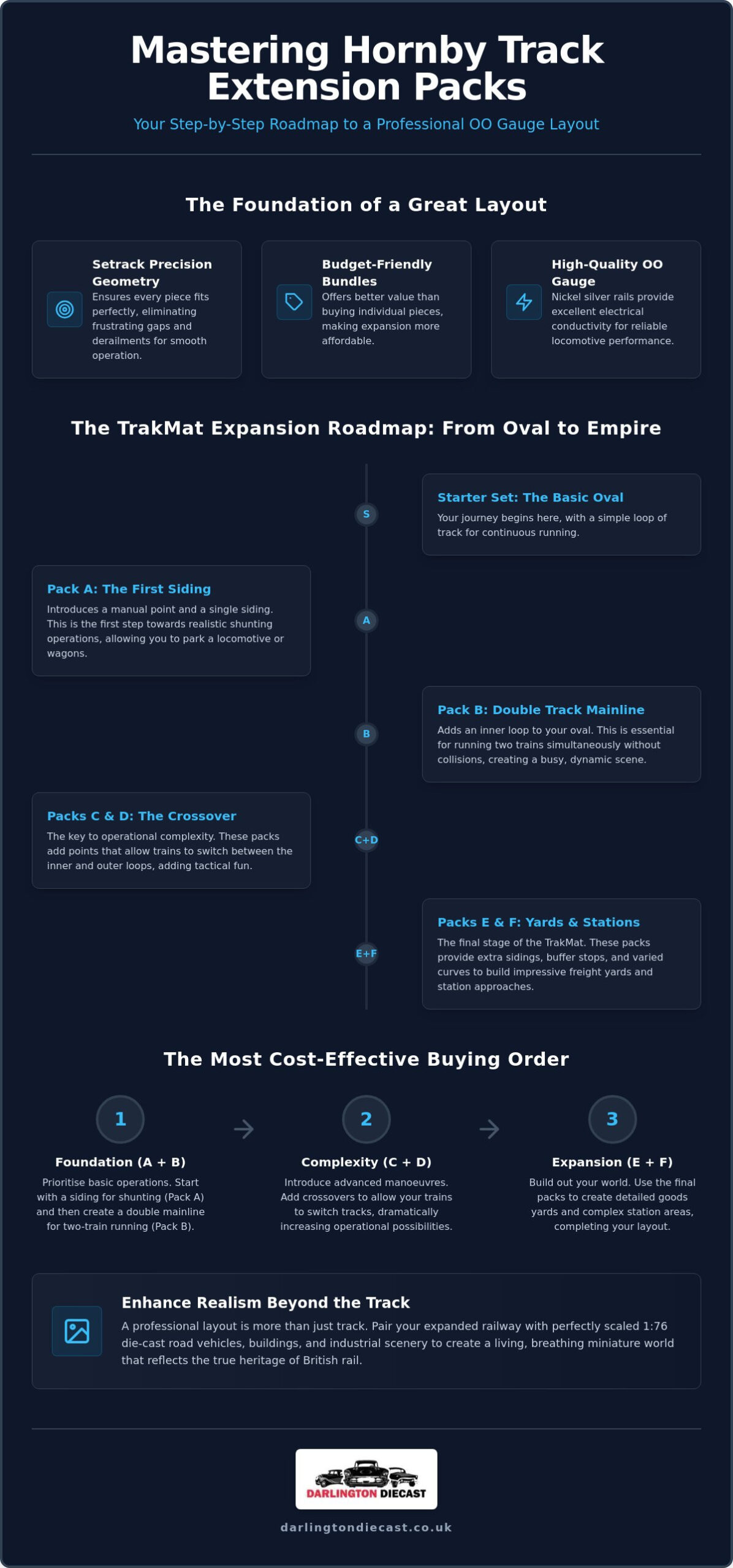
The naming system might look like a random jumble of letters, but it’s actually a carefully planned progression. Each letter represents a specific expansion phase, allowing you to build your layout at your own pace without wasting money on redundant parts. These Hornby track extension packs are designed to stack; you don’t jump from A to F without the pieces in between if you’re following the TrakMat guide. This modularity means you can start small and watch your miniature world grow logically over time.
Pack A & B: The Essentials
Pack A is the logical first step for anyone with a basic starter set. It introduces your very first siding and a manual point, which immediately changes the way you play. Instead of just watching a train go in circles, you can now “park” a locomotive or a couple of wagons. This introduces the concept of shunting, a fundamental part of real railway operations. If you’ve ever seen the National Railway Museum’s model railway, you’ll know that sidings are where the real action happens.
Pack B takes things further by providing the extra curves and straights needed to turn that single line into a double-track mainline. This is essential if you want to run two trains simultaneously without them crashing. It adds a layer of visual depth that makes your board look like a busy British transport hub rather than a toy. You can find these foundational sets amongst our range of Railway Accessories if you’re ready to take that next step.
Packs C through F: Building Complexity
Moving into the later stages, Packs C and D introduce the “crossover.” This is a set of points that allows a train to move from the outer loop to the inner loop. It requires precision and adds a great deal of tactical fun to your operating sessions. Packs E and F focus on expanding your freight yards and station approaches. They include extra sidings, buffer stops to prevent your rolling stock from rolling off the rails, and various radii of curved track to fit tight spaces. The technical components included in these bundles are of the highest quality. You’ll find nickel silver points that offer better electrical pick-up, along with buffer stops that clip firmly onto the end of the rails.
By the time you reach the final pack, your layout will have evolved from a simple circle into a functional network with dedicated spaces for passengers and goods. These packs include:
- Left and Right-hand Points: Essential for directing traffic and creating junctions.
- Buffer Stops: Providing a realistic end to your sidings for safety and realism.
- Standardised Curves: Ensuring your locomotives don’t struggle with tight turns or derailments.
Ultimately, Packs A-F represent a complete evolution from a simple toy to a sophisticated model railway.
Planning Your Expansion: The Most Cost-Effective Order to Buy
Building a layout is a journey, and there’s a definite logic to the order in which you should expand. Whilst it’s tempting to grab every pack at once, a gradual approach is often more rewarding for both your wallet and your skills as an operator. It gives you the chance to enjoy each new shunting possibility or passing loop before moving on to the next challenge. By growing slowly, you can ensure each section is perfectly laid and tested before the next arrival.
- Step 1: The Foundation with Pack A. This is your gateway to operation. It adds a single siding and a point, allowing you to uncouple wagons and store a second locomotive. It’s the most cost-effective way to break the circular monotony of a basic starter set.
- Step 2: Unlocking Two-Train Running with B and C. These two Hornby track extension packs are designed to work in tandem. By installing them in sequence, you create a complete inner or outer loop. This is a game-changer for your layout, as it allows you to have an express train thundering along the mainline whilst a local goods train works the sidings.
- Step 3: Space Evaluation for D and E. Before you invest in these larger sets, take a moment to measure your baseboard. These packs introduce more complex station approaches and multiple sidings, which require a bit more real estate to look realistic and avoid a cluttered appearance.
- Step 4: Customising with Flexi-Track. Once you have the core geometry of the A-F system in place, you can use individual lengths of flexible track to create bespoke curves or longer straights that fit your specific room dimensions.
Custom Layouts vs the TrakMat Route
A common misconception is that you must use the paper TrakMat provided in many starter sets. Whilst it’s a fantastic guide for beginners, many modern modellers prefer to build directly onto a wooden baseboard for a more permanent, professional finish. The alphabet system works perfectly well without the paper mat; the geometry remains consistent regardless of the surface. If you’re planning a more bespoke shape for your room, our guide on mastering your model railway track setup offers deeper insights into advanced board planning and layout design.
Budgeting for Your Hobby
We always suggest a pack-a-month strategy. This keeps the hobby sustainable and ensures you don’t feel overwhelmed by a massive pile of unlaid track. It also gives you time to focus on adding ballast or scenery to one section before moving to the next. Don’t fall into the eBay trap of buying cheap, second-hand track. Older rails often suffer from corrosion or loose fishplates, which lead to poor electrical contact and stuttering trains. Investing in brand-new components ensures a hassle-free experience. As your layout grows, keep an eye on your power supply; a longer circuit might eventually require a more advanced controller to ensure smooth operation across the whole board.
Enhancing Realism: Combining Track Extensions with Scenery and Die-cast Models
A railway layout truly comes to life when the rails stop being just metal and plastic and start telling a story. Whilst the previous sections focused on the technical geometry of expansion, the visual impact of your project depends on how you use that new space. Hornby track extension packs provide the physical footprint for your imagination. They create the necessary room for station platforms, goods sheds, and busy industrial yards that would otherwise feel cramped or unrealistic on a basic starter oval.
The beauty of the OO gauge system is its perfect compatibility with 1:76 scale die-cast models. Since both the track and the vehicles share the same scale, they look exactly right when placed side-by-side. For those building a contemporary scene, placing a Konecranes Reach Stacker in a modern freight siding instantly transforms a simple length of track into a high-stakes logistics hub. If your heart belongs to the golden age of steam, you might instead choose to populate a station forecourt with a Corgi Classic Sports Cars Jaguar XK120 to evoke a sense of mid-century heritage.
Populating Your Sidings
An empty siding can often look a bit lonely on a finished board. To create a “multi-modal” transport hub, you should think about how goods move from the rails to the road. This is where your collection of Oxford Diecast lorries and vans becomes essential. By parking a delivery van next to a goods shed or a flatbed lorry near a crane, you give your locomotives a reason to be there. Era-consistency is key here; a 1950s steam engine looks best amongst vehicles from the same decade, whilst modern diesel shunters pair perfectly with current logistics machinery.
Adding Scale Model Scenery
Packs D and E are particularly useful for scenery lovers because they introduce the complex station approaches and multiple parallel lines that define a major rail centre. This extra width gives you the perfect excuse to install long platforms or double-track engine sheds. To hide the “modular” look of the Hornby track extension packs, we recommend adding a fine layer of ballast between the sleepers and using small grass tufts around the buffer stops. These small tactile details blend the individual track pieces into a seamless, organic landscape. You can explore our full range of Oxford Diecast models to find the perfect vehicles to occupy your new sidings and station yards.
Using railway accessories like telegraph poles, water cranes, and signal boxes further anchors the track into its environment. When you combine the strategic expansion of your rail network with high-quality die-cast models, you move beyond “running trains” and start managing a living, breathing miniature world. It’s about creating a scene where every siding has a purpose and every vehicle has a job to do.
Building Your Dream Layout with Darlington Diecast Models Limited
At Darlington Diecast Models Limited, we act as a bridge between the heritage of large-scale manufacturers and the individual collector’s vision. Our commitment to the British hobbyist is rooted in a genuine passion for the “British Miniature.” We understand that building a layout is a significant journey. That’s why we curate our inventory to include only the most reliable components. We prioritise high-quality Hornby equipment because it represents the gold standard of OO gauge modelling, ensuring your trains run with the precision they deserve. This dedication to quality means we only stock items that meet our rigorous standards for durability and detail.
Logistics matter just as much as the products themselves. Delicate points, curved rails, and buffer stops require careful handling to maintain their perfect geometry. We use specialist packaging to ensure your Hornby track extension packs arrive in pristine condition, ready for immediate use. There’s nothing more frustrating than unboxing a delivery only to find bent rail joiners or cracked sleepers. Our team takes pride in a service-oriented approach that treats every order with the respect a dedicated collector deserves. We ensure every parcel is secured and tracked until it reaches your doorstep.
Expert Advice for Every Stage
Whether you’re just starting with Hornby model train sets or you’re a veteran modeller looking to refine a complex station approach, we’re here to help. Our team provides expert knowledge on how to seamlessly link your track, locomotives, and die-cast models. We love helping customers find that perfect Oxford Diecast vehicle to match a specific era or region. If you’re unsure about pack compatibility or system upgrades, you can always contact us for a friendly chat. We value the collector’s journey and enjoy acting as a trusted advisor for your next big project. Our physical presence allows us to maintain a community-focused atmosphere that welcomes interaction.
Start Your Expansion Today
There’s never been a better time to grow your miniature world. The satisfaction of seeing your first multi-train operation run smoothly across a double-track mainline is hard to beat. It transforms the hobby from a simple pastime into a truly immersive experience. We invite you to explore our range of Hornby Track Extension Packs and take your layout to the next level. Let’s build something extraordinary together. Our team is ready to help you find the specific items you need to complete your vision and evoke that excitement of discovery.
Transform Your Layout into a Masterpiece
Expanding your model railway is a rewarding journey. It blends engineering precision with creative storytelling. By following the modular logic of the A to F system, you’ve seen how easy it is to move from a simple oval to a complex, multi-train network. You now have the roadmap to choose the right Hornby track extension packs at the right time, ensuring your layout grows sustainably and stays within budget. The true magic happens when you integrate 1:76 scale die-cast vehicles and realistic scenery to create a living, breathing British transport hub.
As a specialist UK retailer for collectors, we take pride in our expert knowledge of 1:76 scale integration. We offer a carefully curated range of Hornby, Corgi, and Oxford Diecast products to help you achieve a professional finish. Whether you’re adding your first siding or a complex station approach, we’re here to support every shunt and signal change along the way. It’s time to bring your vision to life.
Browse our Hornby Track Extension Packs and Railway Accessories to find everything you need for your next project. We can’t wait to see your layout in action.
Frequently Asked Questions
Do I need a TrakMat to use Hornby track extension packs?
No, you don’t need a TrakMat to use these packs. Whilst the mat provides a helpful visual guide for placement, the track pieces are standard Hornby Setrack and can be laid directly onto any flat surface or wooden baseboard. Many enthusiasts prefer building on a permanent board to allow for more realistic scenery and ballasting as their layout matures over time.
Are Hornby track packs compatible with other brands like Peco?
Yes, Hornby track packs are compatible with other brands such as Peco, provided you use the “Code 100” range. Both brands utilise the same rail height and profile, allowing them to join together seamlessly with standard fishplates. This flexibility is excellent for collectors who want to mix and match different point types or specialised track sections as their layout becomes more advanced.
What is the difference between Pack A and Pack B?
Pack A is designed to add your first siding and point to a basic oval, which enables simple shunting operations. In contrast, Pack B provides the specific curves and straights needed to extend that single circuit into a double-track mainline. Whilst Pack A focuses on “parking” or storing trains, Pack B is the essential first step toward running two trains simultaneously on separate loops.
Can I use digital (DCC) trains on these track extension packs?
You can certainly use digital (DCC) trains on these Hornby track extension packs. The rails themselves carry the electrical signal regardless of whether you use analogue or digital control. However, for the best DCC performance, we recommend fitting “point clips” to your points. These small metal staples ensure that power reaches all sections of the track, even when the point is switched to a siding.
Is it cheaper to buy the packs or individual track pieces?
Buying the packs is consistently more cost-effective than sourcing individual rail components. Hornby bundles these pieces to offer a lower price point for hobbyists who are gradually expanding their setup. When you factor in the cost of points and buffer stops, which are more expensive when bought separately, the savings found in the extension packs become quite significant for your overall budget.
How much extra space do I need for the full A-F layout?
A full layout incorporating packs A through F typically requires a space of approximately 6 feet by 4 feet (roughly 180cm by 120cm). This footprint matches the dimensions of the standard Hornby TrakMat exactly. If you have less room available, you might choose to stop at Pack C or D, which still provides plenty of operational interest without needing a large, dedicated area in your home.
Do the points in these packs require a motor to work?
The points included in these packs are manually operated out of the box. They feature a small integrated lever that you flip by hand to change the train’s direction. If you eventually prefer remote control, you can easily add Hornby point motors later. This upgrade allows you to switch tracks from a central control panel, adding a professional and convenient touch to your operating sessions.
How do I keep my new track extensions clean for better performance?
Keeping your rails clean is vital for smooth running and prevents your locomotives from stuttering or stalling. We recommend using a specialised track rubber or a lint-free cloth dampened with a small amount of track cleaning fluid. Regular maintenance, especially after you have finished adding scenery or ballast, ensures that the nickel silver surfaces provide the best possible electrical contact for your locomotives. If you’re new to the hobby and want to avoid common pitfalls from the outset, our complete guide to starting a model railway for beginners covers everything from first purchases to ongoing maintenance in 2026.