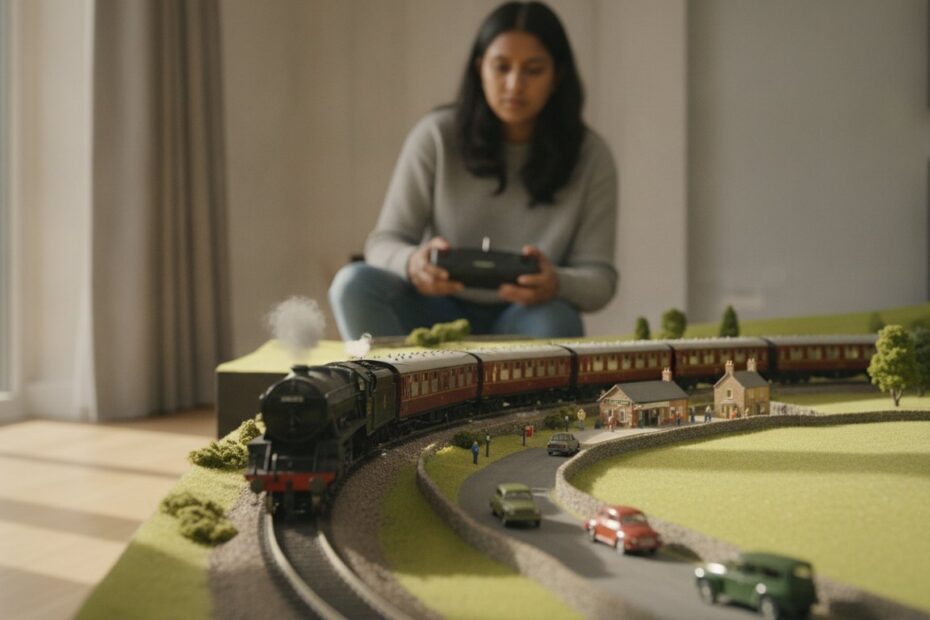
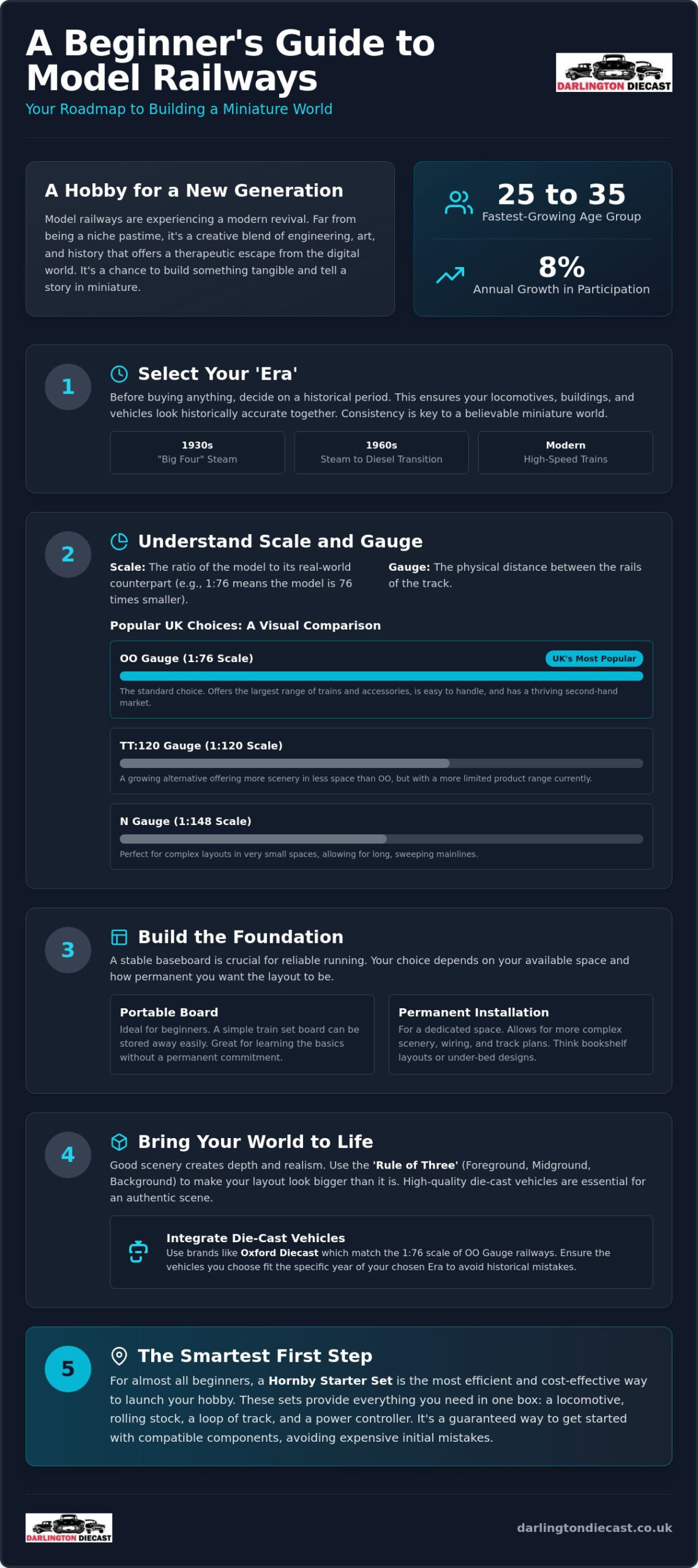
Did you know that the 25 to 35 age group is now the fastest growing segment in the hobby, with participation increasing by up to 8% annually? It is an exciting time to pick up a controller, yet finding a clear path through the technical jargon can be a challenge. Starting a model railway for beginners often brings up worries about limited space in a modern British home or the perceived complexity of new wiring standards, such as the 2026 amendments to BS 7671. You are likely looking for a way to build something beautiful without making expensive mistakes.
We understand that you want your first layout to look authentic without the frustration of parts that don’t fit together. This guide provides a complete roadmap for your first purchase. We ensure you know exactly which brands, like Hornby and Oxford Diecast, work in harmony. You will discover how to select the perfect gauge for your space and how to use die-cast vehicles to create a realistic landscape. From unboxing your first set to the pride of seeing a miniature world come to life, we have everything you need to begin your journey with confidence.
Key Takeaways
- Learn how to select a specific ‘Era’ for your layout, ensuring your locomotives and rolling stock look historically accurate together.
- Understand the differences between scale and gauge to see why OO Gauge is the most popular choice for a model railway for beginners in the UK.
- Discover the importance of a stable baseboard and how to choose between a portable train set board and a permanent installation.
- Master the ‘Rule of Three’ in scenery to create depth and realism using high-quality Oxford Diecast vehicles and railway accessories.
- Find out why a Hornby starter set is the most efficient and cost-effective way to launch your first miniature world in 2026.
Introduction to Model Railways: Starting Your Journey in 2026
Rail transport modelling is a unique blend of engineering, art, and historical research. It offers a creative outlet that few other pastimes can match. Whilst many start by unboxing a train set on the living room floor, the true magic begins when you decide to build a “layout”. This term represents a shift in mindset; you aren’t just running a train, you’re curating a miniature environment where every signal, building, and vehicle tells a story.
A common hurdle for a model railway for beginners is the worry about space. Modern British homes don’t always have room for a dedicated railway room. However, you don’t need a sprawling loft to enjoy this hobby. Bookshelf layouts, “N” gauge dioramas, and clever under-bed designs are incredibly popular in 2026. These compact projects allow you to focus on high levels of detail without needing a massive footprint.
Why Choose Model Railways as a Hobby?
The appeal of the railway is truly multi-generational. It provides a rare opportunity for family members to bond whilst learning valuable technical skills, from basic electronics to landscape painting. In a fast-paced digital world, the “slow” nature of modelling is therapeutic. Whether you are weathering a locomotive or wiring a point motor, the focus required offers a refreshing break from daily screens. The UK remains a global hub for this hobby, boasting a vibrant community of clubs that ensure you never build in isolation.
Defining Your Theme and Era
Before you buy your first locomotive, it’s vital to choose an “Era”. This concept helps you maintain a consistent look. You might prefer the “Big Four” era of the 1930s with its iconic streamlined steam engines, or perhaps the “Transition” period of the 1960s where diesel power began to replace the last of the steam giants. Modern Image themes allow you to model the high-speed trains and colourful liveries seen on the network today.
Your choice of location is just as important as the timeframe. A quiet rural branch line requires different stock and scenery than a bustling city terminus. Realism depends on these details. For example, ensuring your Oxford Diecast vehicles match the specific year of your railway prevents jarring historical errors. A 1950s station scene would look odd with a modern reach stacker parked nearby, so careful planning at this stage saves time and money later.
Understanding Scales and Gauges: Finding Your Perfect Fit
Choosing your first scale is a critical decision when starting a model railway for beginners. This choice dictates how much scenery you can fit into your available room and which locomotives you can collect. Many new hobbyists use the terms ‘scale’ and ‘gauge’ interchangeably, but they refer to different things. Scale is the ratio of the model compared to the real world, whilst gauge is the physical distance between the rails. In the UK, OO Gauge is the most common standard, using a 16.5mm track width to represent a scale of 1:76.
The dominance of OO Gauge means you have access to a massive ecosystem of products. This includes an extensive range of Hornby Model Train Sets, which often serve as the ideal foundation for a first layout. Because 1:76 is the British favourite, you’ll also find that accessories from Oxford Diecast and Corgi fit your scenes perfectly. If you are interested in exploring how different rail widths can change the feel of your project, you might find this guide to planning a narrow gauge layout useful for understanding niche track standards.
OO Gauge: The British Standard
Starting with OO Gauge is often the most cost-effective path due to the sheer volume of support in the second-hand market. Decades of production mean you can find everything from steam-era branch line stock to modern diesel locomotives with ease. These models are large enough to handle comfortably, making them perfect for those who enjoy fine-detailing their rolling stock. They also pair naturally with highly detailed 1:76 scale road vehicles, such as the Corgi Classic Sports Cars Jaguar XK120, ensuring your entire miniature world remains in proportion.
Space Requirements for Different Scales
For most enthusiasts, the choice of scale is a compromise between ambition and the dimensions of their home. Whilst N Gauge (1:148) allows for long mainlines in a tiny spare room, TT:120 (1:120) has recently become a popular ‘Goldilocks’ scale. It offers more presence than N gauge but requires roughly 25% less space than a traditional OO layout. The table below provides a rough guide to the minimum space needed for a basic oval loop in each scale.
| Scale (Ratio) | Common Name | Minimum Space for a Loop |
|---|---|---|
| 1:76 | OO Gauge | 6′ x 4′ (183cm x 122cm) |
| 1:120 | TT:120 | 4′ x 3′ (122cm x 91cm) |
| 1:148 | N Gauge | 3′ x 2′ (91cm x 61cm) |
If you don’t have room for a full circuit, an ‘end-to-end’ shelf layout is a brilliant alternative for a model railway for beginners. These designs fit onto narrow boards in hallways or alcoves and focus on the realistic operation of a small station or industrial siding. You can browse our curated selection of railway accessories to find the signals and trackside details that make these compact scenes come to life.
Building the Foundation: Baseboards, Track, and Power
A model railway is only as good as the surface it sits on. One of the most common mistakes when starting a model railway for beginners is setting up track on a carpet or an uneven table. These surfaces cause the track to flex, leading to frustrating derailments and poor electrical contact. Before you lay a single rail, you must decide between a portable “train set on a board” or a permanent layout. A portable board is brilliant if you need to store the railway away, whilst a permanent layout allows you to fix buildings and scenery in place for a more professional finish.
You don’t need an extensive workshop to get started, but a few specific tools are essential for a smooth build. Track cutters are vital for trimming rails without crushing the metal, and a small hammer helps secure track pins without damaging the plastic sleepers. A spirit level is also non-negotiable; even a slight, unintended gradient can prevent a long train from climbing a hill. Once your track is laid, keep it clean. Electrical continuity is the lifeblood of your railway, and a quick wipe with a track rubber ensures your locomotives run without stuttering.
Constructing a Sturdy Baseboard
Stability is the goal here. I recommend using 9mm or 12mm birch plywood for the top surface, supported by a frame of 2×1 inch timber bracing. This structure prevents the wood from warping when you apply glue or paint for scenery. If woodwork feels daunting, ready-made laser-cut baseboards are an excellent alternative for 2026. These kits slot together with precision, providing a perfectly flat foundation in minutes. After securing your board, you can focus on mastering your model railway track setup to ensure every joint is flush and every curve is smooth.
DC vs DCC: Choosing Your Control System
Powering your layout involves choosing between two distinct systems. DC (Direct Current) is the traditional analogue method. It’s simple to wire; you turn a dial, and the locomotive moves. However, if you have two trains on the same track, they will both move at once. DCC (Digital Command Control) is the modern standard. It uses a digital signal to talk to each locomotive individually, allowing you to park one train at a station whilst another zooms past on the same line.
For a thorough breakdown of these systems, the National Model Railroad Association’s Beginner’s Guide offers fantastic technical insights. Many newcomers start with DC to keep initial costs lower, but it’s wise to future-proof your hobby. When buying locomotives, look for those labelled “DCC Ready”. These models contain a socket that allows you to plug in a digital decoder later, making the transition to advanced control effortless as your skills develop.
Bringing it to Life: Scenery and Die-cast Vehicle Integration
Scenery provides the essential context that transforms a loop of track into a plausible world. Think of your layout as a stage where your locomotives perform their daily duties. Without a surrounding environment, even the most expensive train looks like a toy. When building a model railway for beginners, the “Rule of Three” is a helpful framework to follow. This involves layering your scene into the foreground (the track and immediate ballast), the midground (buildings, roads, and figures), and the background (the backscene that provides depth). By focusing on these three layers, you create a sense of scale that draws the eye into the miniature world.
Road vehicles are often the unsung heroes of this process. They provide the “road-rail” interface that grounds your railway in reality. A broken-down car on a country lane or a delivery van parked outside a station instantly tells a story. However, you must ensure your vehicles match the scale of your trains. For an OO gauge layout, always select 1:76 scale vehicles to maintain a consistent look. Using the wrong scale, such as 1:43 cars alongside OO trains, will immediately break the illusion of realism.
Scenery Essentials for Beginners
You don’t need to be a master artist to create convincing landscapes. For immediate visual impact, grass mats or static grass starters are excellent choices. They cover large areas quickly and provide a uniform base for further detailing. When it comes to structures, “Skaledale” or other pre-built resin buildings are a lifesaver. These models come fully painted and weathered, allowing you to avoid the frustration of complex plastic kits whilst achieving a professional finish. You can find a comprehensive list of must-have items in our guide to railway accessories.
Enhancing Realism with Oxford Diecast and Corgi
Specific vehicle choices reinforce your chosen era. A Corgi Classic Sports Cars Jaguar XK120 parked in a 1950s station car park provides an instant historical anchor. For those modelling a modern freight yard, the Oxford Diecast Konecranes Reach Stacker adds a sense of industrial purpose. These high-quality models offer the fine detail required to stand up to close inspection alongside modern locomotives.
To make your scenes look natural, avoid placing vehicles perfectly parallel to the track or roads. In the real world, things are rarely “square”. Parking a van at a slight angle or placing a tractor diagonally in a field creates an “un-planned” look that mimics real life. This small adjustment makes a significant difference in the final appearance of your model railway for beginners. Explore our full range of Oxford Diecast models to find the perfect vehicles to populate your new miniature world.
The First Step: Choosing the Right Hornby Starter Set
The transition from admirer to owner begins with a single box. For anyone exploring a model railway for beginners, a complete starter set is the most logical and cost-effective investment. These sets provide a curated selection of track, a locomotive, rolling stock, and a power controller in one package. By purchasing a set, you avoid the risk of buying incompatible components, ensuring your first experience is one of success rather than technical frustration. Iconic sets featuring the ‘Flying Scotsman’ or ‘Mallard’ remain the gold standard for steam enthusiasts, offering a piece of British heritage that looks magnificent on any layout.
One of the most significant advantages of starting with a major brand is the structured expansion path. Hornby uses a logical ‘Track Pack’ system, lettered from A to F. This allows you to grow your layout systematically. You might start with the basic oval included in your set, then add Track Pack A to create a siding, eventually progressing through the letters to build a complex network of loops and spurs. This modular approach prevents you from feeling overwhelmed, allowing your skills and your miniature world to grow at the same pace.
Why Start with a Complete Train Set?
Modern Hornby sets are designed for “plug-and-play” simplicity. You don’t need to be an electrician to get your trains moving; the components are engineered to work together perfectly the moment they are unboxed. Many of these sets also include a ‘TrakMat’. This is a large, printed paper base that shows you exactly where to place your track, buildings, and roads. It serves as a brilliant visual guide for initial scenery placement, helping you see the potential of your project before you commit to permanent fixtures.
Expanding Your World with Accessories
Once you are comfortable running your first train, the next step is to add operational variety. Adding a simple siding or a small goods shed creates a destination for your trains, allowing you to practice shunting manoeuvres. You can find detailed advice on this process in our Hornby track extension pack guide. These packs are the simplest way to add complexity to your track plan without needing to calculate individual rail lengths.
As you move beyond the initial oval, we invite you to browse Darlington Diecast for a wide range of railway accessories and collector models. Whether you are adding a signal box or a fleet of Oxford Diecast delivery vans, each addition makes your layout more unique. That first turn of the controller is just the beginning of a lifelong journey. With a bit of patience and the right starting set, you will soon find yourself lost in the rewarding world of railway modelling.
Your Journey to a Miniature Masterpiece Starts Here
Building a model railway for beginners is a rewarding path that combines technical skill with artistic vision. By now, you understand the importance of choosing a consistent era and scale, constructing a stable baseboard, and using starter sets to grow your layout logically. Integrating high-quality road vehicles from Oxford Diecast or Corgi ensures your scene feels grounded and authentic. It is about more than just track; it’s about creating a living history in your own home.
As an official Hornby, Corgi, and Oxford Diecast stockist, Darlington Diecast is here to support you at every stage. We offer friendly expert advice and reliable UK-wide delivery on all orders, ensuring your new hobby gets off to the best possible start. Whether you’re unboxing your first locomotive or detailing a complex freight yard, the satisfaction of seeing your miniature world in motion is unparalleled. Explore our range of Hornby Starter Sets and Railway Accessories today and begin your modelling adventure with confidence.
Frequently Asked Questions
What is the best model railway scale for a beginner with limited space?
N Gauge (1:148) is traditionally the best choice for tight spots, but the new TT:120 (1:120) scale is a brilliant alternative for 2026. It offers more presence and detail than N gauge whilst requiring significantly less room than a standard OO layout. It is often the perfect compromise for a modern apartment or a bookshelf project.
Can I run different brands of trains on the same track?
Yes, you can mix brands as long as they share the same gauge. Most British manufacturers use the standard OO gauge coupling system and track standards. This means you can run a Hornby locomotive with wagons or carriages from other reputable brands on your layout without any compatibility issues.
Is it better to start with a steam or a diesel train set?
The choice depends entirely on your preferred era and personal taste. Steam sets like the Mallard offer nostalgic charm and mechanical interest, whilst diesel sets reflect the modern railway network. Both provide an excellent starting point for a model railway for beginners and include everything you need to get moving.
How much does it cost to start a basic model railway layout in 2026?
The initial investment depends on whether you choose an analogue or a digital system. A complete starter set is usually the most affordable way to begin, as it bundles the locomotive, track, and power supply together. Costs will grow naturally as you add more track extension packs, buildings, and highly detailed scenery items.
Do I need to be good at electronics to use DCC control?
You don’t need advanced technical knowledge to use modern DCC systems. These controllers are designed for simplicity with clear menus and intuitive handheld units. Most new locomotives come “DCC Ready”, which means you simply plug in a digital chip to enjoy independent control of multiple trains on the same track.
What is the difference between OO gauge and HO gauge?
The main difference is the scale of the models. OO gauge is 1:76, which is the British standard, whilst HO gauge is 1:87, which is common in Europe and the USA. Both run on the same 16.5mm track width, but OO models are slightly larger to accurately represent the smaller loading gauge of real British trains.
How do I keep my model train track clean for better performance?
Clean track is essential for consistent electrical contact and smooth running. Use a dedicated track rubber to remove oxidation or a lint-free cloth with a small amount of specialised track cleaning fluid. Regular maintenance prevents your trains from stuttering or stalling, especially at slower speeds over points.
Can I use old die-cast cars on my new model railway layout?
You can certainly use die-cast cars if they match the scale of your trains. For a standard model railway for beginners in OO gauge, look for 1:76 scale models from brands like Oxford Diecast. These provide the correct proportions for station car parks and street scenes, ensuring your miniature world looks realistic and balanced.