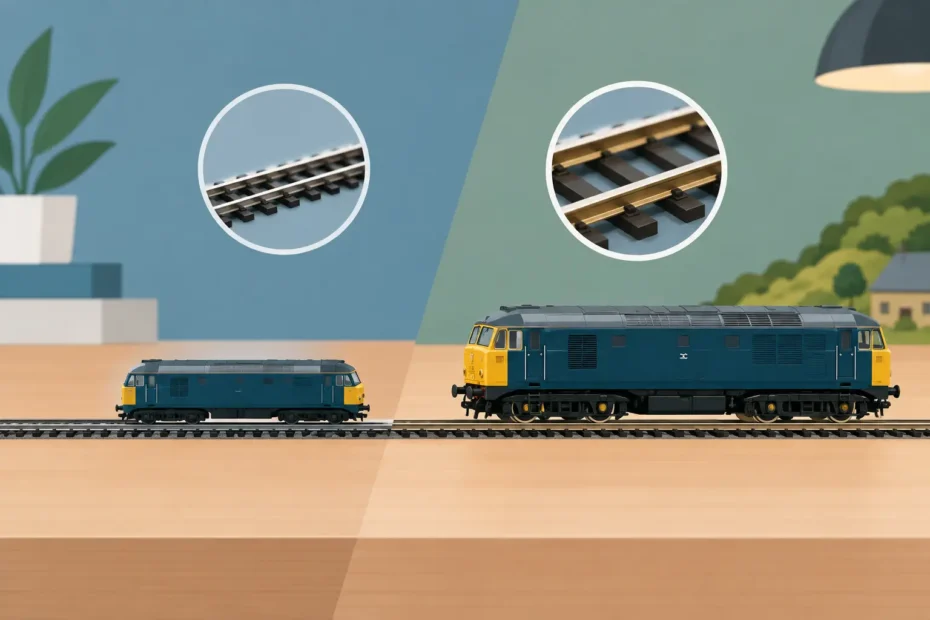
A spare-room railway with long mainline runs has very different needs from a compact layout on a shelf, and that is where the N gauge versus OO gauge decision begins. Both scales offer excellent British locomotives, rolling stock, track and scenic accessories, from heritage steam to current-era diesel and electric operation. The right choice is not simply the smaller one or the more detailed one. It is the gauge that gives you the sort of railway you want to build, run and enjoy for years.
N Gauge Versus OO Gauge: The Essential Difference
OO gauge is the most familiar scale in British model railways. Models are built to 1:76 scale and run on 16.5mm track. It has an enormous range of locomotives, coaches, wagons, buildings and accessories, with well-known names including Hornby, Bachmann and Oxford Rail represented across many periods.
N gauge is smaller, usually 1:148 for British-outline models, and runs on 9mm track. The reduction sounds modest until the two are side by side. An N gauge coach is around half the volume of its OO equivalent, allowing much more railway in the same footprint.
Neither is automatically better. OO brings physical presence and highly visible detail; N gauge brings scale length, wider scenery and the possibility of a convincing railway where space is tight. Both can be straightforward for a first layout, provided the plan matches the available room and your own patience for handling smaller parts.
Space Is Usually the Deciding Factor
If your ambition is a branch-line terminus with a platform, goods shed and a handful of sidings, OO gauge can work beautifully on a modest board. A simple 6 ft x 4 ft layout, for example, can provide satisfying continuous running and plenty of opportunity for shunting. A shelf layout or end-to-end plan can be even more compact.
The challenge comes when you picture a long express train, broad curves and a station with several platforms. OO stock needs room to look natural. Tight curves can be useful in hidden sidings or a small industrial scene, but a large Pacific locomotive or modern passenger train looks far happier sweeping around broader bends. Once platforms, roads, buildings and a realistic distance between places are added, an OO main line can quickly take over a spare room.
N gauge changes that calculation. On a 6 ft x 4 ft board, there is room for longer trains, a double-track circuit and a more generous station scene. In a larger room, N gauge makes it possible to model a substantial junction, a rural route that genuinely travels through open countryside, or a modern freight operation with convincing train lengths.
That does not mean every N gauge layout has to be busy. One of its greatest strengths is the ability to leave space between settlements, give a river or hillside proper scale, and make a small station feel part of a wider railway. If the available area is limited to a bookcase, a narrow shelf or a corner of a home office, N gauge deserves particularly serious consideration.
Detail, Presence and Hands-On Enjoyment
OO gauge has an immediate appeal when viewed up close. Cab interiors, printed lining, separately fitted handrails and weathering are easier to appreciate, while coaches and wagons have a reassuring weight and presence. For collectors who enjoy displaying a favourite locomotive or recreating a particular local scene, that extra size can matter as much as operational possibilities.
It is also friendlier for less nimble hands. Couplings are easier to see and adjust, and fitting a decoder, adding passengers or replacing a detail part is generally less fiddly. Younger enthusiasts often find OO stock easier to handle, though careful supervision is still sensible with delicate models.
Modern N gauge models are remarkably refined, with fine livery printing, etched details and smooth mechanisms. Yet they reward a lighter touch. Small coupling springs, buffer details and wheelsets are easier to misplace, and track needs to be laid with care. N gauge is not beyond a beginner, but it suits someone happy to work neatly and methodically.
Scenery is another matter of taste. OO offers a wonderfully tactile modelling experience, whether you are constructing a stone station, adding fencing or placing 1:76 scale vehicles around a depot. N gauge scenery can create a more expansive visual effect, although individual details are naturally subtler. A well-planned N gauge landscape often looks more like a real railway viewed from a distance; an OO scene invites closer inspection.
Running Trains: What Each Gauge Does Best
For shunting, OO gauge is hard to beat. The larger models make uncoupling and wagon handling easier, and slow-speed movements are enjoyable to watch. A compact goods yard, colliery or diesel depot can provide hours of operation without needing an enormous layout.
N gauge excels at the sense of a railway in motion. A ten-coach express or lengthy freight can run through a scene without looking compressed into a circle. This makes it an excellent match for people drawn to main-line operation, dramatic landscapes and watching trains pass through rather than constantly rearranging stock.
Track quality and good electrical connections matter in both scales. Clean rails, carefully aligned joints and reliable point motors do more for enjoyable running than simply choosing the latest locomotive. Digital Command Control is available in OO and N gauge too, allowing individual locomotives to be controlled independently. It is worth allowing for DCC from the planning stage if sound, multiple-train operation or finer control appeals, even if you begin with conventional analogue running.
Is N Gauge Cheaper Than OO Gauge?
The answer is mixed. Individual N gauge locomotives and coaches can sometimes cost a little less than their OO equivalents, but not always. Highly detailed releases, limited runs and DCC-fitted models can command similar prices in either scale. Do not choose a gauge on the assumption that it will be a budget option.
N gauge may need less track and fewer baseboards to create the railway you have in mind, which can save money and domestic space. On the other hand, its compact size makes it tempting to add more sidings, longer formations, extra buildings and more scenic detail. OO can encourage a more focused collection, but larger structures, wider-radius points and the need for additional boards may raise the total project cost.
A sensible approach is to price the whole first stage: a locomotive, a few vehicles, controller, track, points, baseboard materials and basic scenery. Leave room in the budget for a track cleaner, spare couplings and the inevitable item that becomes your new favourite.
Compatibility Matters Before You Buy
OO and N gauge models, track, structures and vehicles cannot be mixed on the same working layout. Their scales are visibly different, and the track gauges are incompatible. It sounds obvious, but newcomers sometimes see a vehicle or station accessory they like without checking the stated scale.
When building a consistent scene, match the scale wherever possible. OO is often paired with 1:76 road vehicles, while British N gauge works best with 1:148 accessories. Some generic scenery can be used with either, but figures, doors, fencing and cars reveal a mismatch quickly.
Era matters too. A 1930s steam locomotive can share a collection with a modern diesel if you enjoy the models individually, but a layout usually looks more convincing when its locomotives, road vehicles, advertising and buildings tell the same time period.
Which Gauge Should You Choose?
Choose OO gauge if you want models with strong display presence, enjoy hands-on detailing and shunting, or have enough space for curves and platforms that suit the trains you love. It is also an excellent route if friends or family already run OO, since borrowing ideas, track plans and practical experience is part of the fun.
Choose N gauge if your priority is a broad railway in a compact space. It makes particular sense for long passenger trains, modern freight, sweeping landscapes and layouts where a realistic journey matters more than large individual models. A small flat, study or shared hobby room need not rule out an ambitious railway when N gauge is on the table.
There is a third answer, of course: collect one scale and build the other later. Many enthusiasts begin with a few locomotives they simply like, then discover the type of layout that will suit them. Seeing stock side by side is useful here. At Darlington Diecast, being able to examine the proportions of locomotives, coaches and accessories in person can make the choice far clearer than a photograph on a screen.
Start with the train that has stayed in your mind – perhaps a favourite BR steam locomotive, a DMU from childhood holidays or a modern lorry-loaded freight service. Then give that train the space, curves and surroundings it deserves. The gauge will usually reveal itself.