
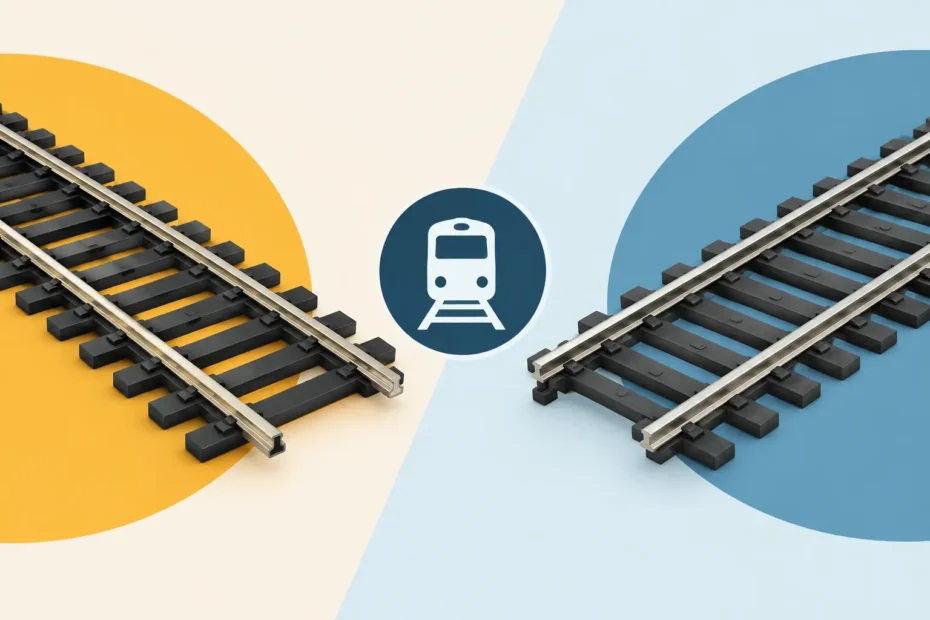
A track plan can look perfect on paper, then become frustrating when a point leaves too little room for a platform or a curve puts a long coach on the floor. That is why Hornby track versus Peco track is not simply a question of which make is better. It is a choice about the kind of railway you want to build, the stock you run and how much freedom you need as the layout grows.
For a first OO gauge railway, Hornby is familiar, straightforward and widely used in train sets. Peco offers equally useful beginner-friendly pieces, plus a much broader route into realistic trackwork and bespoke designs. Both are respected British names, both can form the basis of a reliable layout, and both can be combined with care. The best choice is usually the one that suits your space rather than the label on the sleepers.
Hornby track versus Peco track at a glance
Hornby’s standard OO track system is designed around fixed geometry. Curves, straights, points and crossings are made to connect in predictable combinations, which makes it particularly approachable for layouts built from a set, a plan book or a compact board. If you want to put an oval on a 6 x 4 ft board and add a passing loop or siding, the available sections make the process easy to visualise.
Peco has two distinct strengths. Its Setrack range works in much the same practical, fixed-radius way as Hornby set-track, making it a sensible alternative or companion for uncomplicated plans. Peco Streamline is different: it uses flexible track and a much wider choice of points, crossings and rail profiles. This is where builders gain the freedom to ease curves, create realistic sidings and arrange stations that do not look constrained by a few standard lengths.
Neither approach is automatically superior. Fixed geometry saves time and reduces uncertainty. Flexible track takes more planning and careful laying, but it can make a layout feel far less like a circle of train-set track.
Rail profile and appearance
Most modern Hornby OO track uses Code 100 rail. The number refers to the rail height in thousandths of an inch. Code 100 is sturdy, forgiving and suitable for a very broad mix of British OO locomotives and rolling stock, including many older models with deeper wheel flanges.
Peco offers Code 100 in both Setrack and Streamline, so this is the simplest place to mix the two brands. At a glance, the rail height is similar and the track is generally compatible using the right joiners and sensible alignment.
Peco Streamline is also available in Code 75 for OO. Its lower rail profile gives a more refined, closer-to-scale appearance, especially when ballasted and weathered. It is popular with modellers building contemporary or exhibition-style layouts, but older stock with coarse wheel flanges may strike the chairs or sleepers. Before committing to Code 75, test the oldest locomotives and wagons you intend to run, not only your newest purchases.
Appearance is about more than rail height. Hornby track is ideal when the priority is getting trains moving quickly. Peco flexible track lets you avoid repeated short straight sections between curves, helping long main lines look more natural. Once painted, ballasted and surrounded by scenery, either can look impressive, but Peco gives the experienced builder more scope to refine the result.
A note on sleeper spacing
OO gauge track represents standard-gauge railway track at 4 mm to the foot, although traditional OO track gauge is slightly wider than true scale. This is normal for British OO modelling. The visual difference between Hornby and Peco is usually less significant than good ballasting, appropriate weathering and curves that suit the length of the trains being run.
Curves, space and the stock you run
The minimum curve radius is often the deciding factor on a first layout. Hornby’s standard first-radius curves are useful where space is tight, but they can look sharp and may be less comfortable for long coaches, large steam locomotives and some modern diesels. Second-radius curves are a better all-round starting point where space permits, while wider curves improve both appearance and running.
Peco Setrack provides familiar fixed radii, so it is easy to plan compact curves. With Streamline flexible track, you can set almost any radius you need. That does not mean tighter is better. Flexible track is best used to create flowing curves with a consistent radius, ideally easing into and out of them rather than forcing an abrupt change of direction.
If your collection includes long Mk3 coaches, Pullman stock, large Pacifics or modern passenger units, give those models the space they deserve. A slightly larger board, or a plan with a simple circuit rather than several cramped sidings, often delivers more enjoyment than trying to fit every feature into one corner.
Points are where the comparison matters most
A point is not merely a piece of track that changes direction. Its geometry affects train length, platform space, electrical wiring and how convincingly a station throat or goods yard looks.
Hornby points are designed to integrate neatly with its standard track geometry. They are a practical choice for beginner layouts, especially when building from sectional pieces. Hornby point motors can also be fitted simply, making powered operation accessible without turning the project into a wiring exercise from the outset.
Peco Setrack points fulfil a similar role. Peco Streamline points offer greater variety, including small, medium and large-radius designs, curved points, three-way points, slips and crossings. This is valuable when you are recreating a particular track plan or want a yard that has the irregular, purposeful look of the real railway.
The trade-off is that finer trackwork asks more of the builder. Points need to sit perfectly level, be firmly supported and have reliable electrical connections. A point that is slightly twisted, or installed with a sudden curve immediately before it, can cause recurring derailments that no locomotive service will cure.
Insulfrog, Electrofrog and Unifrog
Peco point terminology can seem daunting at first. Insulfrog points have an insulated frog and are the most straightforward option for many analogue and DCC layouts. Electrofrog points use a live metal frog, which can improve slow-speed running but normally requires more deliberate wiring and attention to polarity. Unifrog designs give the modeller the option to wire the frog for improved performance while remaining usable without that extra connection.
For a simple layout with modern, reliable locomotives, an insulated-frog point may be entirely adequate. For a slow-moving shunting layout, especially with short-wheelbase locomotives, live-frog or wired-frog arrangements can be worthwhile. The right answer depends on the locomotives, the controller and your willingness to undertake electrical work.
Can Hornby and Peco track be mixed?
Yes, particularly in OO Code 100, but mix it thoughtfully rather than treating every piece as interchangeable. Rail joiners must fit securely, rail tops need to meet at the same height, and the track must be aligned accurately. A slight step at a join can cause derailments or uncoupling, particularly with lightweight wagons.
The more significant issue is geometry. A Hornby point and a Peco point may not occupy exactly the same length or produce the same exit angle. Replacing one in an existing layout can therefore alter the position of every section beyond it. Plan substitutions before cutting track or fixing it to the baseboard.
Mixing brands can be very practical. A modeller may use Hornby curves and straights to get a railway running, then choose Peco flexible track for a scenic extension or a more realistic yard. Keep transitions deliberate, test each new section before ballasting, and avoid relying on a piece of track to pull a misaligned joint into place.
Which is best for a beginner?
For a first railway, Hornby track is hard to fault when you want clear options, predictable geometry and a quick route from box to running trains. It suits family layouts, starter sets and compact boards where the aim is enjoyment without a lengthy construction phase.
Peco Setrack deserves equal consideration for that same type of layout, especially if the required pieces or points better suit your plan. Peco Streamline is an excellent next step for newcomers who are happy to learn a little more, have a larger space or already know they want a less geometric appearance.
Do not assume that choosing Peco means building an advanced layout, or that choosing Hornby means settling for a basic one. Plenty of enjoyable, detailed railways use standard sections well. Equally, flexible track is not difficult once you understand the need for smooth curves, firm fixing and repeated testing.
Make the choice before buying in bulk
Sketch the board size, mark where stations and sidings need to go, then lay out a few representative pieces before committing to a full shopping list. Place your longest coach alongside the planned platform, and run your least forgiving locomotive through any tight curves and points. This small test can save considerable expense later.
If possible, see the different track pieces up close and compare the points against your plan. At Darlington Diecast, railway enthusiasts can examine products in person as well as browse the wider range for their next layout project.
Choose Hornby when simple, dependable set-track geometry is the priority. Choose Peco Streamline when realistic curves and detailed track plans matter most. Whichever route you take, a well-laid piece of track will bring more pleasure than a complicated plan that never quite runs properly.