
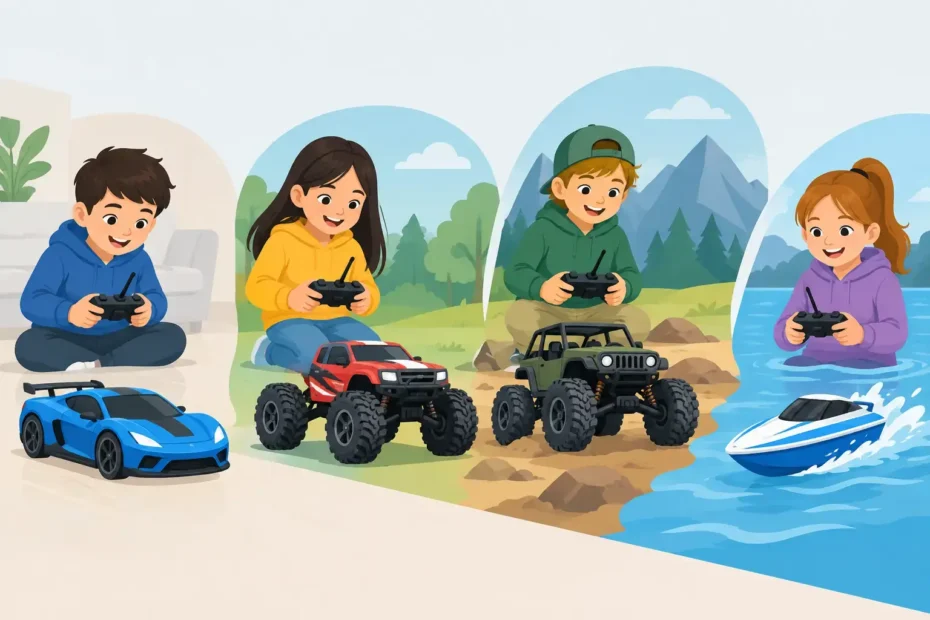
A radio-controlled vehicle is far more memorable when it suits the child behind the controller. The best RC vehicles for children are not always the fastest, biggest or most detailed models. They are the ones a young driver can steer confidently, recharge or replace batteries for without frustration, and enjoy again after the inevitable collision with a kerb, table leg or garden pot.
For a first RC gift, it is tempting to choose by appearance alone. A bright sports car, monster lorry or stunt buggy can certainly create that all-important wow factor, but age guidance, speed, terrain and controller design matter just as much. Get those details right and an RC vehicle can become the start of a lasting interest in cars, motorsport, engineering and collecting.
Start with the child’s age and confidence
Age recommendations are a useful starting point because they reflect more than just small parts. They usually indicate the complexity of the controls, the vehicle’s speed and the level of supervision likely to be needed. A child who is just discovering radio control benefits from a simple model that goes forwards, backwards, left and right without demanding pinpoint steering.
For younger children, look for a chunky vehicle with a straightforward handset and a modest top speed. Large buttons or clearly shaped controls are easier for small hands than a compact pistol-grip transmitter. A slow, stable car lets them practise turning and stopping before a collision becomes dramatic. Toy-grade RC cars are often ideal here: they are designed for accessible fun rather than adjustment, tuning or high-speed running.
Children aged around six to nine can often manage more responsive steering and a vehicle intended for the garden, driveway or park. At this stage, a monster lorry or off-road buggy makes sense because larger tyres and higher ground clearance cope better with uneven paving, short grass and small stones. They also tend to shrug off the bumps that come with enthusiastic driving.
Older children who have already mastered a basic RC model may enjoy a faster buggy, rally car or more realistic licensed vehicle. This is where it pays to think about how they will use it. A quick model is exciting in an open space, but less suitable for a busy pavement, a small back garden or indoor play. Speed should feel like a reward for control, not a substitute for it.
Best RC vehicles for children: match the model to play
There is no single right body style. The best choice depends on where the vehicle will run and what catches the child’s imagination.
Monster lorries for forgiving outdoor fun
Monster lorries are among the most practical choices for younger drivers and family garden use. Their oversized tyres help them clear rougher surfaces, while their high stance reduces the chance of getting stuck on a twig or change in ground level. They are also brilliantly theatrical: climbing over small obstacles and bouncing across grass makes every run feel like an event.
The trade-off is that a tall vehicle can roll over more readily when turned sharply. That is rarely a problem with a sturdy beginner model, but it is worth teaching children to slow down before a tight turn. Choose one with a protected body shell and wheels that are securely fitted rather than purely decorative.
Buggies for speed and open spaces
An RC buggy has a lower profile, a sporty look and usually sharper handling than a monster lorry. It is a strong option for children who enjoy racing siblings or setting up a simple course with cones, plant pots or chalk lines. On smooth tarmac, a buggy feels lively without needing an enormous amount of power.
Buggies are less happy in long grass, mud or loose gravel, particularly smaller models with narrow tyres. If the intended track is the patio, driveway or local hard-standing area, that is no drawback. If it is mainly the lawn, a monster lorry is likely to offer more running time and fewer retrieval missions.
Licensed cars for young vehicle enthusiasts
For a child who can name their favourite supercar, racing machine or film vehicle, a licensed RC model brings an extra layer of enjoyment. The appeal is not only driving it but recognising the shape, livery and details. It can also sit neatly alongside a growing collection of diecast cars when it is not in use.
Realistic road cars are normally best on clean, flat surfaces. Low bodywork and smaller wheels look excellent but are more vulnerable to kerbs, gravel and wet grass. They suit a careful driver and an indoor hall, garage floor or smooth driveway better than an adventurous garden circuit.
Stunt vehicles for quick, shared play
Stunt RC cars with spinning bodies, double-sided designs or oversized wheels are made for instant action. They are often good for younger children because a rollover does not always end the run. Their antics can keep several children entertained, particularly when turns are short and everyone wants a go.
They are not the best option for a child hoping to learn realistic steering or race around a course. Think of them as a lively play vehicle rather than a miniature version of a real car. That distinction helps when choosing a birthday present for a child who is already interested in particular makes, racing or model vehicles.
The controls can make or break the gift
A controller should feel natural within a few minutes. Traditional twin-stick handsets are familiar to many adults and give separate control over steering and throttle. They can be excellent for older children, but younger users may find them easier after a little demonstration.
Pistol-grip controllers use a wheel for steering and a trigger for acceleration and braking. They often feel intuitive once a child has held one, especially for a car or buggy, but hand size matters. If possible, see the controller in person before buying. At Darlington Diecast, a visit to the shop can be particularly helpful for gift buyers who want to judge the scale of a vehicle and the feel of its controls rather than relying on a photograph.
Avoid assuming that more functions are automatically better. Lights, sounds, selectable speeds and special stunt modes can add fun, but a child who is new to RC will usually get more enjoyment from reliable forward motion and steering than from a controller covered in buttons.
Battery choice affects how often it gets used
Battery arrangements deserve a closer look than they usually receive on the box. A vehicle powered by standard AA or AAA batteries is simple to set up and convenient for occasional use. Keeping a spare set ready can rescue a rainy afternoon, although frequent battery replacement soon becomes expensive.
Rechargeable battery packs offer better value for regular driving and are common in more capable RC vehicles. Check whether a charging cable or mains adaptor is included, how long charging takes and whether the controller needs separate batteries. A long charge for a very short run can disappoint an eager child, so realistic expectations matter.
Adult supervision is sensible when charging any rechargeable pack. Charge on a clear, non-flammable surface, use the supplied equipment where possible and allow the battery to cool after a run before charging it again. It is a small routine that protects both the model and the fun.
Check durability, spares and where it will be driven
Children test RC vehicles properly. They drive into fences, puddles and each other. Look for flexible plastic bumpers, a body shell that sits securely, protected wheels and clear advice on whether the model is suitable for outdoor use. Water-resistant is not the same as waterproof: a damp driveway may be fine, while a deep puddle can end the day early.
For a vehicle that will be used often, consider whether replacement parts or compatible batteries are available. A more detailed hobby-style model may be repairable and upgradeable, which can be rewarding for an older child with adult help. A simpler toy-grade model may not be designed for repairs, but it is usually easier to operate straight from the box. Neither approach is inherently better – it depends on whether the priority is uncomplicated play or a hobby that can grow over time.
Also consider the running location before choosing the scale. A compact RC car is easier to store and safer indoors, while a larger 1:10-style vehicle needs room to stretch its wheels. Always use a clear space away from roads, parked cars, pets and people who are not expecting a fast-moving model around their ankles.
Make the first few runs part of the present
The best first session is not a race to maximum speed. Set out a simple route, show the child how gently to use the throttle and let them practise stopping before turning. A few cardboard boxes or safe markers can create a course that makes a modest RC car feel far more exciting.
Choose a vehicle that matches their confidence now, while leaving room for their enthusiasm to grow. When a child can control it, care for it and recognise it as their own favourite machine, an RC model becomes more than a toy – it is a proper little vehicle adventure waiting for the next clear afternoon.